
Arkor documentation
Deploy a Next.js app from GitHub, with cached content served from Cloudflare's CDN.
Arkor is in alpha. What is described here works today, and may still change. Changes that affect you are announced in the changelog.
By default, Arkor builds your project's services from its connected GitHub repository whenever
you push to its production branch. For Next.js, it serves cached page shells from Cloudflare's
CDN and streams the dynamic parts. Each project gets an address of its own at
<project>.arkor.app, and can be served under your own domain as well.
Get started
- Quickstart: sign in, import a repository and publish your first deployment.
- Next.js support: the versions and features Arkor builds, and what to change before you deploy.
- Moving from Vercel: what carries over, what to change and how to move a domain.
Deploy
- Deploy from GitHub: connect repositories, choose the production branch and deploy on push.
- Builds and deployments: follow a build, read its log and redeploy.
- Troubleshooting: what each failure means, and what to check when the site does not answer as you expect.
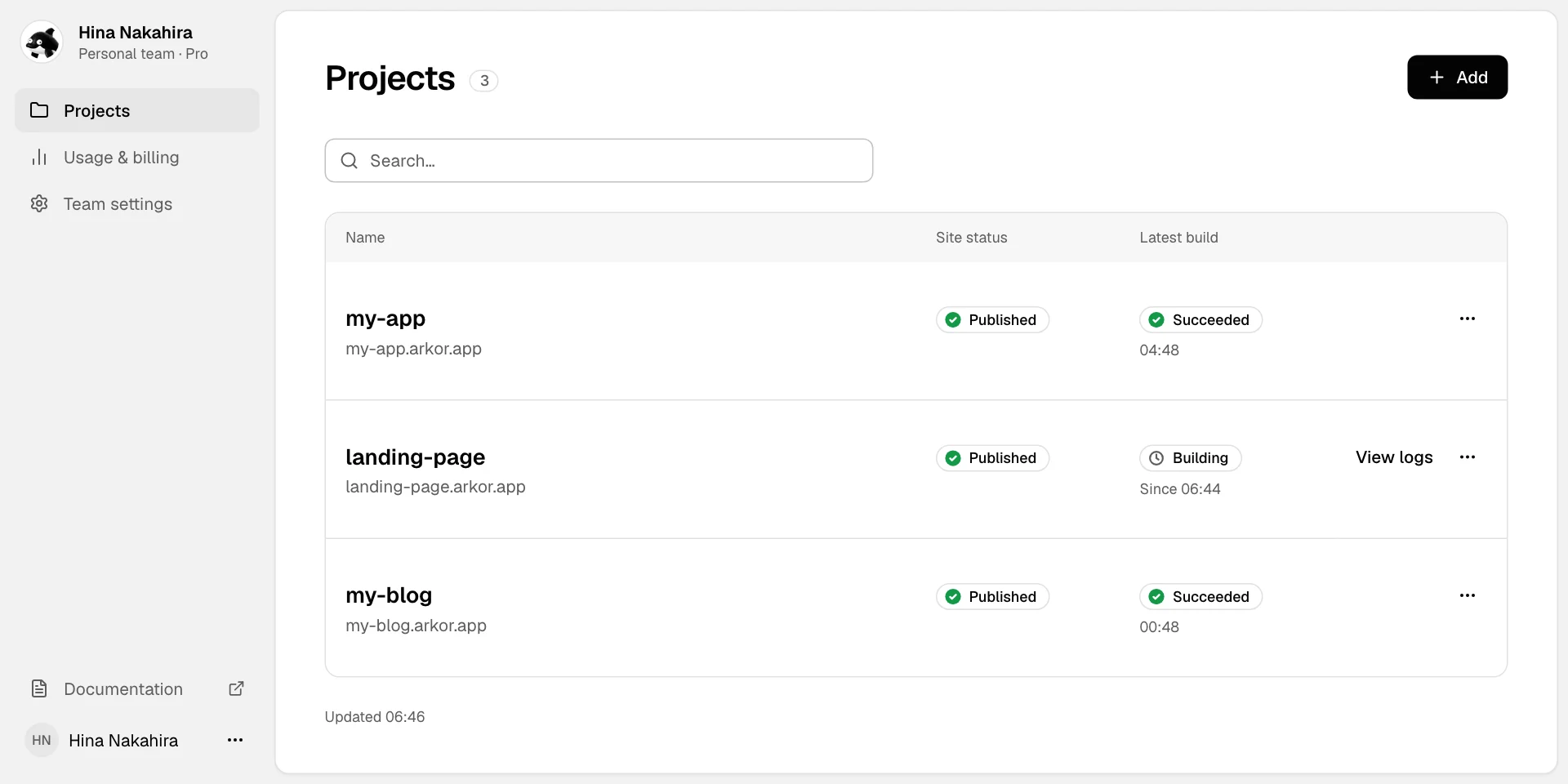
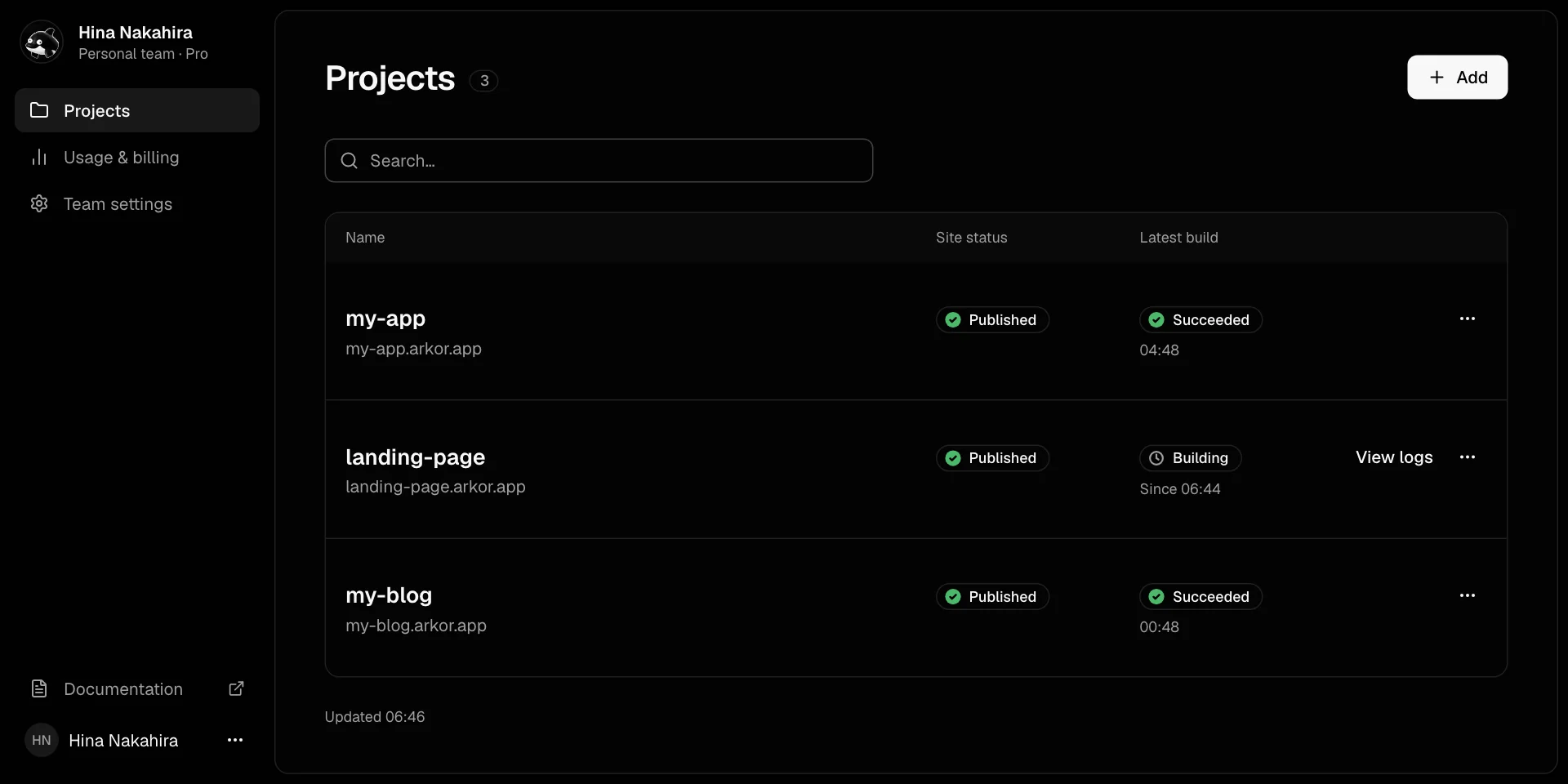
- Projects: what the Projects page and a project's Overview show.
- Services and releases: combine a frontend, API and private Worker, then deploy or restore them together.
- Environment variables, Custom domains, Bindings, Cron jobs, Email and OIDC federation.
- Access protection: keep a project private behind a password, share links, Google or GitHub sign-in, or team membership.
Cache and debug
- ISR and caching: revalidate by time, tag or path, as on any Next.js server.
- Cache Inspector: see every generation, invalidation and tag of a deployment's cache.
- Inspecting a build and Response headers: check what was built and how a request was served.
Observe
Team, billing and API
- Teams and roles, Plans and billing and Usage.
- API tokens, the Public API and Remote MCP.
Common questions
Do I have to change my app?
Usually not: your repository needs no Arkor package and no configuration file. A Next.js app that
uses storage or private service connections
adds @stayingupwind/sdk; a native Hono or fetch app uses
its env bindings. Not everything a Node.js server runs
works on Arkor, though; check
What to change before you deploy.
Can my app use a database?
A database your app reaches over HTTPS, with fetch or a client built on it, is reached as any
other API your app calls. Drivers that open a TCP connection, such as pg and mysql2, have not
been verified on Arkor. A project can also have a D1 database of its own; see
Storage.
Where do builds run, and where is data kept?
Builds run in western North America, and that is where Arkor keeps what it records about your projects: their settings, environment variables, deployments, build logs and the history the Cache Inspector records. The privacy policy lists who processes data for Arkor.
What happens if I stop using Arkor?
A Next.js app that uses neither managed storage nor private service connections needs no Arkor dependency, so the same app builds wherever Next.js runs. If you use those bindings, replace their integrations when you move. Keep your own copy of secret environment variables: Arkor never shows them again once they are saved.
How is Arkor billed?
Per team. Your personal team can deploy on the free plan, which includes some usage each month and never charges anything. The Pro plan, which any other team needs, is billed in US dollars through Stripe. Members are not billed; see Plans and billing.
Which frameworks and Git hosts does Arkor support?
Next.js is recommended and remains the main supported framework, including static exports. SvelteKit 2 and 3, built with Vite, also support static generation and SSR on Cloudflare. Astro 6–7, React Router 7–8, TanStack Start 1, Nuxt 3–4 and SolidStart 1–2 also support native Workers SSR through their supported official build integrations. Hono and Worker-compatible fetch handlers deploy with native static assets and automatic source entrypoint detection. GitHub is the supported Git host.