
Usage
See what your projects used this month, what it costs, and what is not counted.
Usage & billing, in the sidebar, shows what the team's projects have used, meter by meter and project by project. Owners and admins see the current subscription period, and on the free plan the team's owner sees the plan's current month; everyone else sees the calendar month in UTC, as does everyone on a team with no plan.
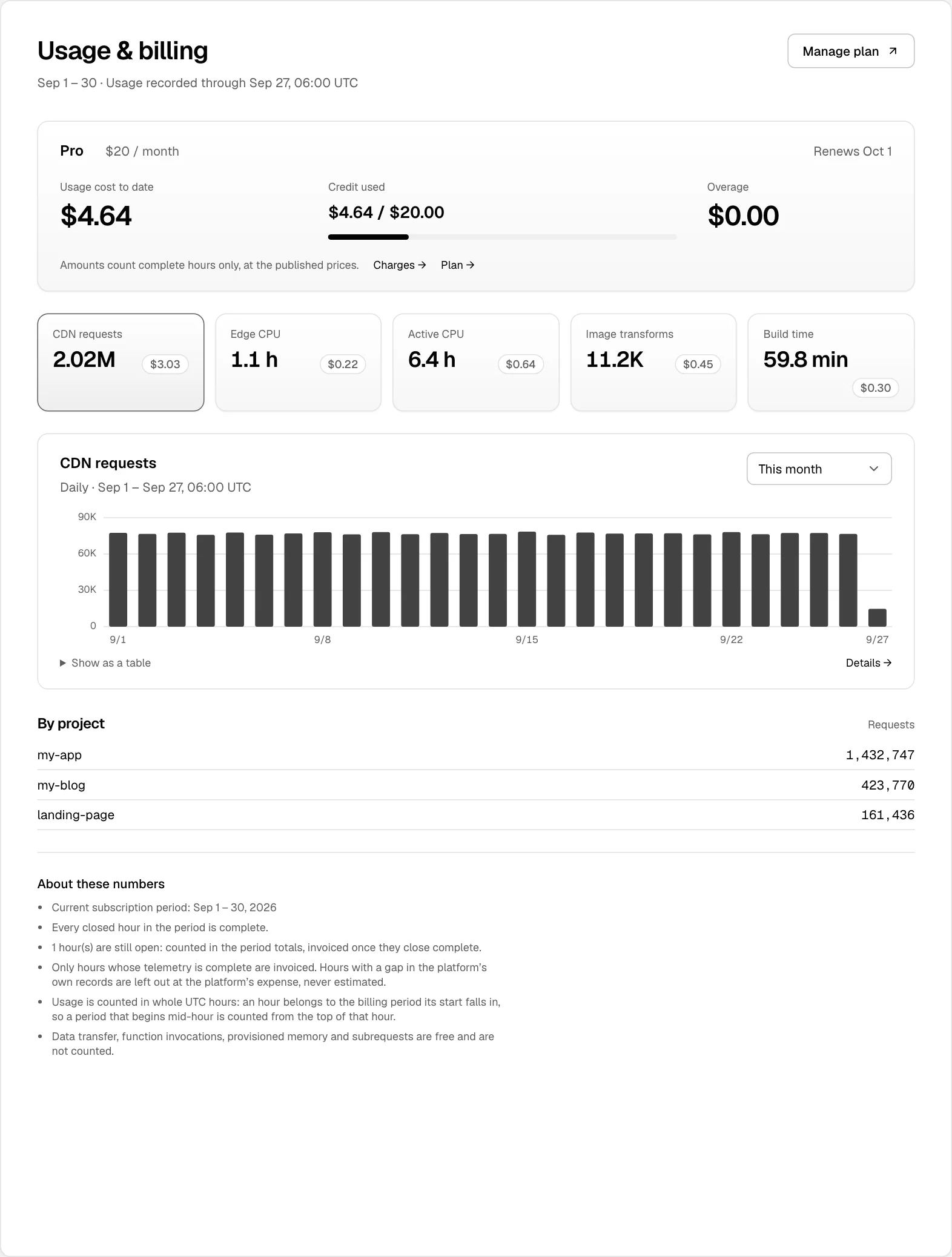
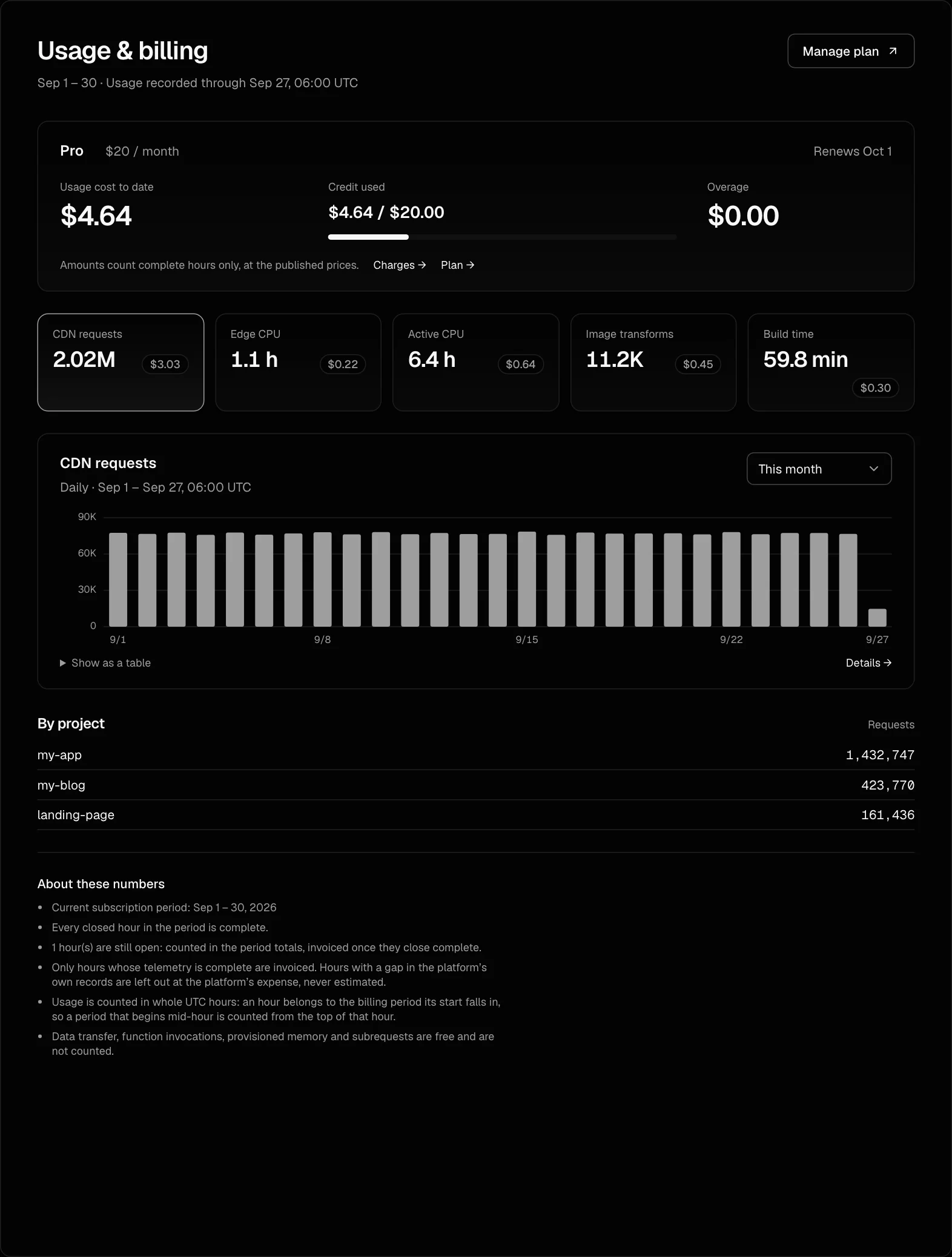
Meters
| Meter | What is counted |
|---|---|
| CDN requests | Every request the edge answered for your projects: pages, files, API calls and redirects. |
| Edge CPU | CPU time the edge spent on those requests. The first 10 ms of each request are free; the rest is counted in 10 ms steps. |
| Active CPU | CPU time your app and your middleware spent on requests. |
| Image transforms | Images transformed for /_next/image and authorized native Images outputs. Information requests and outputs served again from the transform cache are not counted again. |
| Build time | Minutes of build machine time, for every build that ran, whether its deployment then succeeded, failed or was canceled. |
| ISR reads | Reads from your deployments' ISR cache storage, in units of 8 KB: a cached page the edge read from storage and served, and a cached page or data your app read from storage. What the edge served from memory, a cache miss and a tag lookup are not counted. |
| ISR writes | What your deployments wrote to their ISR cache, in units of 8 KB: a regenerated page, and data cached with fetch or 'use cache'. A regeneration whose output is the one it replaces, a value cached again unchanged, what the build rendered, and invalidations are not counted. |
| Inspectable ISR writes | The same writes, for a deployment the Cache Inspector records, counted in place of ISR writes. |
| KV reads | Keys read from your projects' KV namespaces, a key that was not there included, as Cloudflare counts them. |
| KV writes | Keys written to your projects' KV namespaces. |
| KV deletes | Keys deleted from your projects' KV namespaces. |
| KV lists | List requests made of your projects' KV namespaces. |
| KV storage | What your projects' KV namespaces held: each day's peak, a GB kept for a day counting as a thirtieth of a GB-month. |
| R2 Class A | Operations that write to or list your projects' R2 buckets in Standard storage: uploads, copies, multipart uploads and listings. |
| R2 Class B | Operations that read from your projects' R2 buckets in Standard storage: gets and heads. |
| R2 storage | What your projects' R2 buckets held in Standard storage, objects and their metadata: each day's peak. |
| R2 IA Class A | Class A operations on objects stored in Infrequent Access. |
| R2 IA Class B | Class B operations on objects stored in Infrequent Access. |
| R2 IA storage | What your projects' R2 buckets held in Infrequent Access: each day's peak. |
| R2 IA retrieval | Data read or copied out of Infrequent Access storage. |
| D1 rows read | Rows your projects' D1 databases read, their read replicas' included. |
| D1 rows written | Rows your projects' D1 databases wrote. |
| D1 storage | What your projects' D1 databases held: each day's largest size. |
| Durable Object requests | HTTP requests, RPC sessions and alarms received by your projects' Durable Object namespaces, as Cloudflare counts them. |
| Durable Object duration | Time your projects' Durable Objects remained active, measured in GB-seconds. Pending I/O and background work can keep an object active after a request finishes. |
| Durable Object rows read | SQLite rows read by your projects' Durable Objects, including their key-value storage operations. |
| Durable Object rows written | SQLite rows written by your projects' Durable Objects, including key-value storage operations, deletes and alarm writes. |
| Durable Object storage | Each namespace's daily peak SQLite storage across its objects, including production and preview namespaces. |
| Workers AI Neurons | Approved public Workers AI inference, measured in Neurons independently of site CPU. |
A unit of the ISR meters is 8 KB (8,192 bytes). Each read and each write is rounded up to whole units, and counts as at least one. Sizes are as stored: a page stored compressed counts at its compressed size.
The storage meters count what your projects' storage used, at Cloudflare's unit rates. A meter marked Not billed yet is displayed but not charged. See the pricing page. The meters are counted by the UTC day. A day is read from Cloudflare once it has ended, and read again a day later; until then the page says how many days are provisional. A storage GB is 2^30 bytes, and a GB kept for a day is one thirtieth of a GB-month. Cloudflare uses 10^9 bytes for Durable Object storage; Arkor uses the same byte count with its larger storage GB, so that difference is paid by Arkor rather than added to your bill. A day that could not be read in time, and a figure Cloudflare could only estimate, are left out and not billed, and the page says how many there were.
Durable Object duration is Cloudflare's reported GB-seconds, already weighted by allocated memory; it is not multiplied by memory again or converted using the storage GB definition. Native Durable Object CPU is not also added to Active CPU, which counts the calling app and middleware. See Cloudflare's Durable Object pricing for how native requests, duration and SQLite operations are counted. Temporary Durable Object namespaces used for deployment checks are separate from these customer meters; Arkor pays their usage.
Choose a meter to chart it, and Details for its own page: its total, a chart by day and one of the last 48 hours, and each project's share.
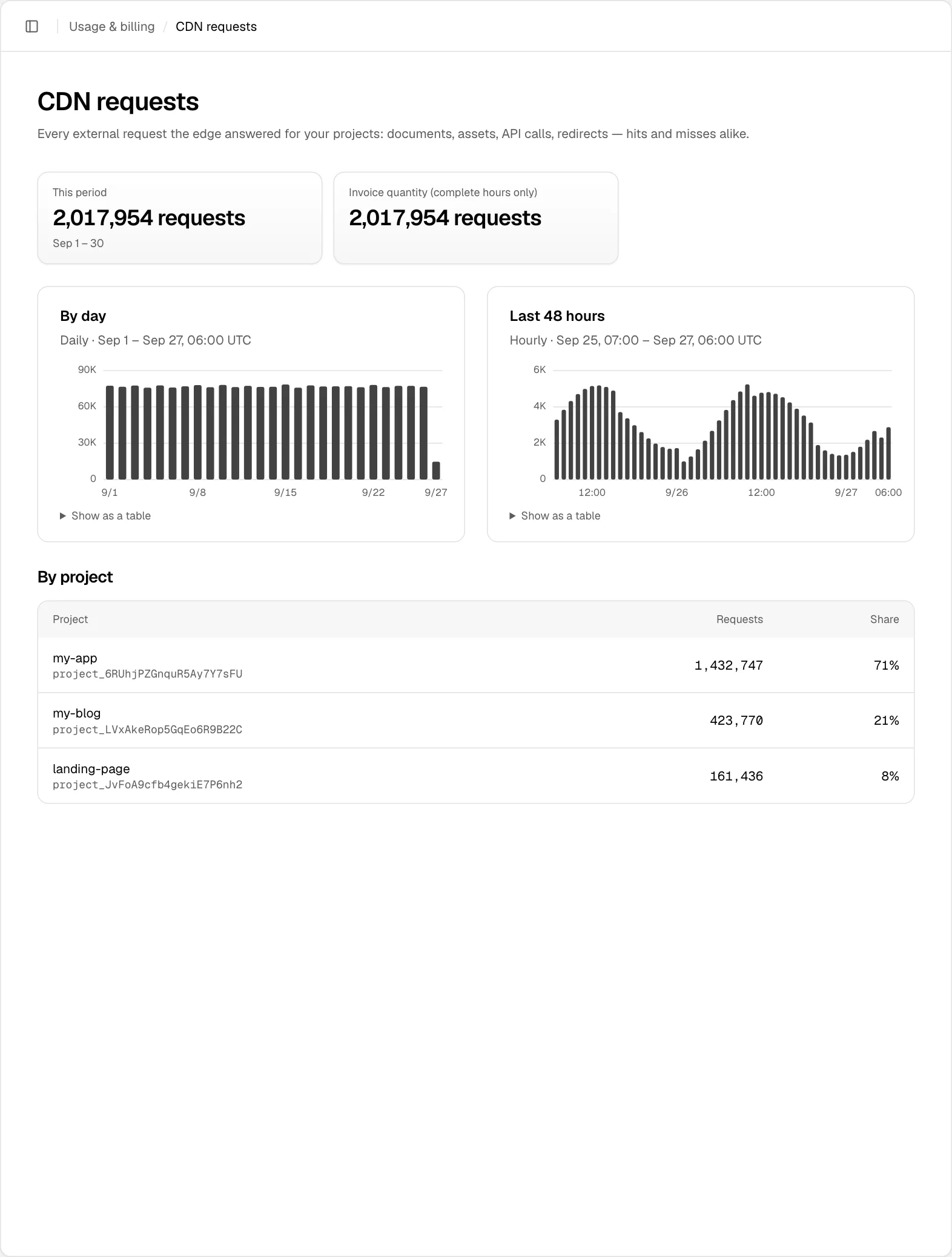
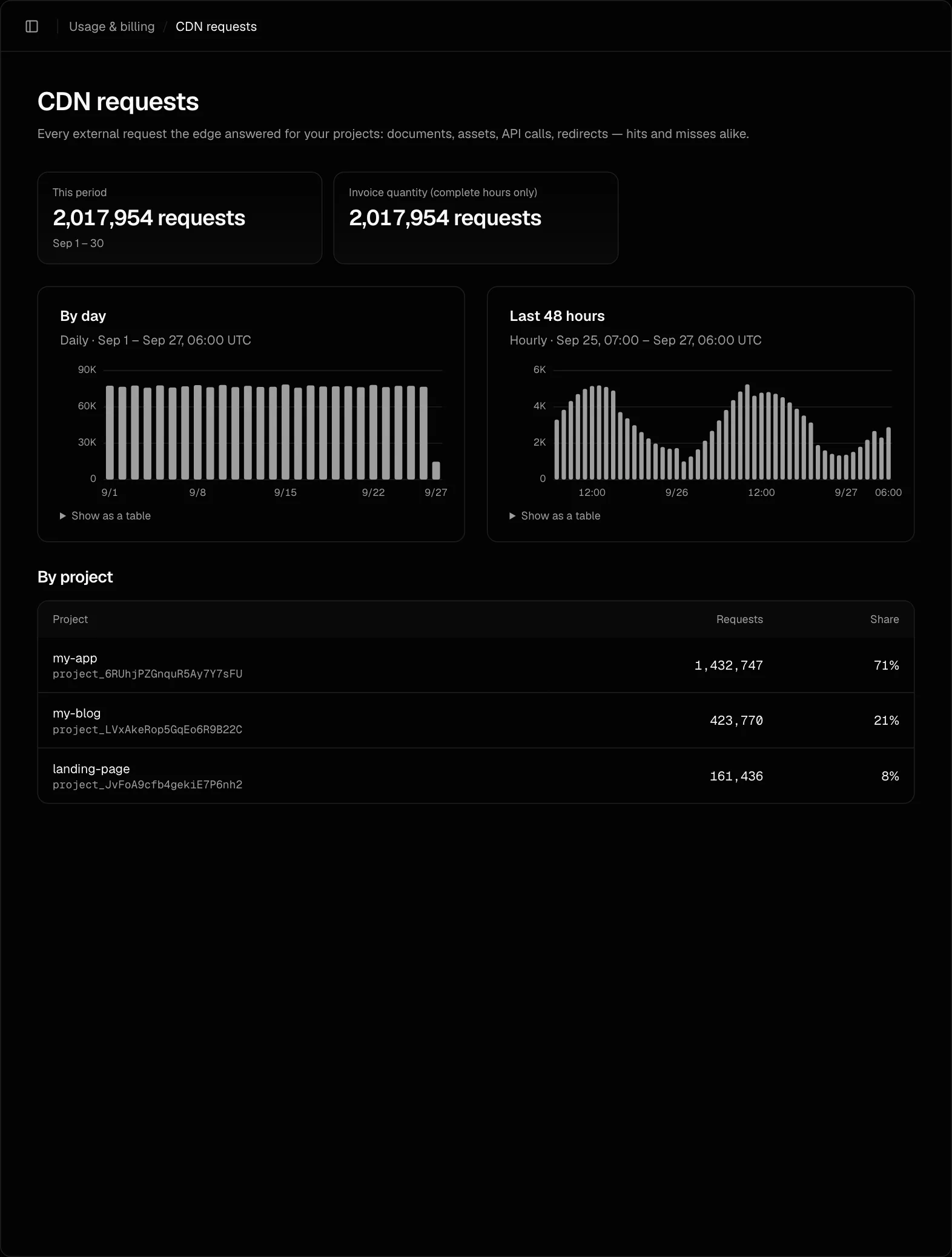
Not counted, and free for ordinary app functions: data transfer, function invocations, provisioned memory and subrequests. Durable Object requests and active duration have their own meters above; their stored data remains metered while a site is paused or a removed namespace is kept for retained deployments.
Costs
Owners and admins see the cost of each meter at the prices on the pricing page, and how much of the month's $20 credit is used. Charges lists each meter's quantity and amount, minus what the plan includes. Only the amount over the credit is billed. A meter marked Not billed yet is counted and shown, and left out of the cost.
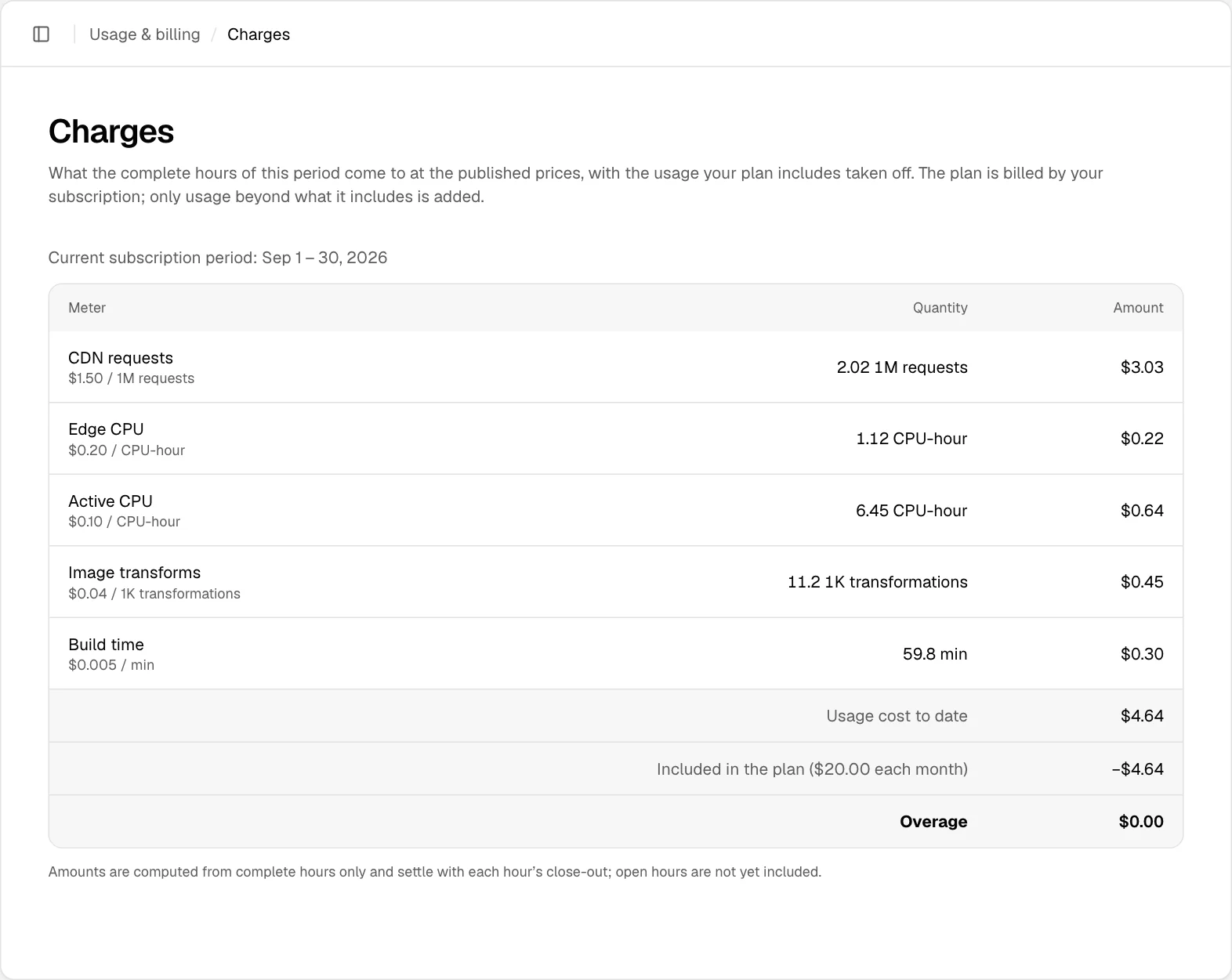
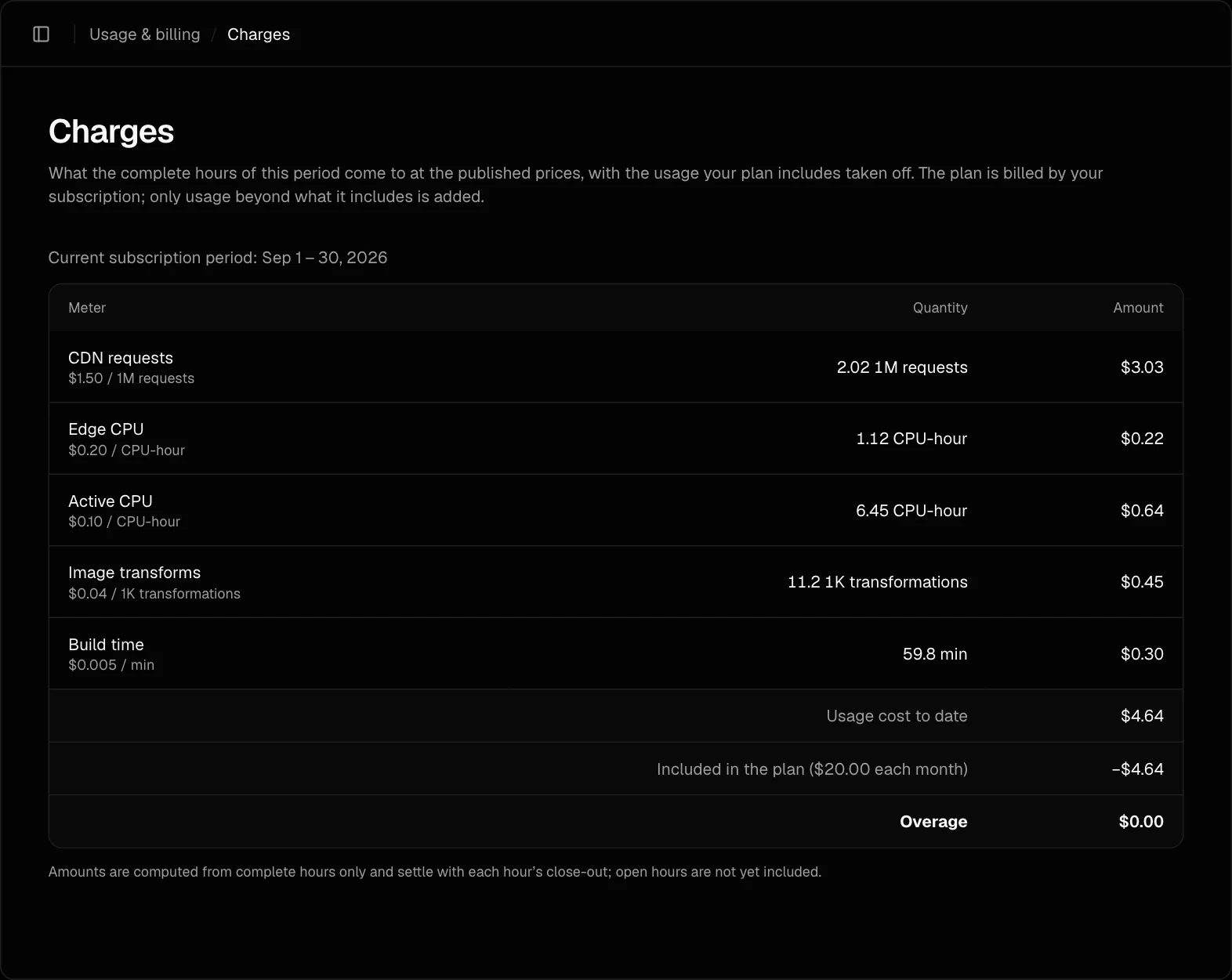
- Usage is counted by the hour, in UTC. An hour belongs to the billing period it starts in.
- Only complete hours are billed. An hour the platform could not record completely is left out, and not billed.
- The credit is set against each month's usage on its own; unused credit does not carry over.
- With a spend limit, a month is billed no more than the limit beyond its credit. Charges shows the usage past the limit, which is not billed.
On the free plan, nothing is billed. The team's owner sees how much of the month's included usage is used, and when the next month begins. Every meter counts toward it, and no cost is shown meter by meter; Charges is for Pro's periods only. Once the month has used what it includes, everyone in the team sees This month's free usage is used up at the top of the page until the projects serve again.
Workers AI
AI inference costs $0.011 per 1,000 Neurons, at Cloudflare's published price. The shared account's free allowance is not repeated per customer. Fractional Neurons are preserved. Only exact, settled hours are invoiced; provisional and sampled hours are shown as estimates, and missing hours are excluded. These measurements settle independently of site telemetry, and AI GPU work is not also billed as Active CPU. Collection continues for accepted inference after a pause or deletion, under its original attribution.
A team paused for its spend limit, or because its month on the free plan has used what it includes, cannot start new inference. In-flight inference may finish, and its measurements may arrive later. The existing invoice cap limits what the team is billed; Arkor pays usage beyond it. This is not a strict per-call reservation of provider consumption.